
Introduction
It is interesting for both founders and investors to investigate the types of AI startups available nowadays. For founders to find the white spaces, for investors to see through the AI hype. To do so, it is important to use various chatbots and analyze the responses.
In this post, the different types of AI startups are described along with their characteristics. This makes use of a matrix with Science and (market) Impact as the axes. Subsequently, the subtle differences between chatbots are examined. In doing so, ChatGPT and Copilot are taken a closer look.
AI Startup Types
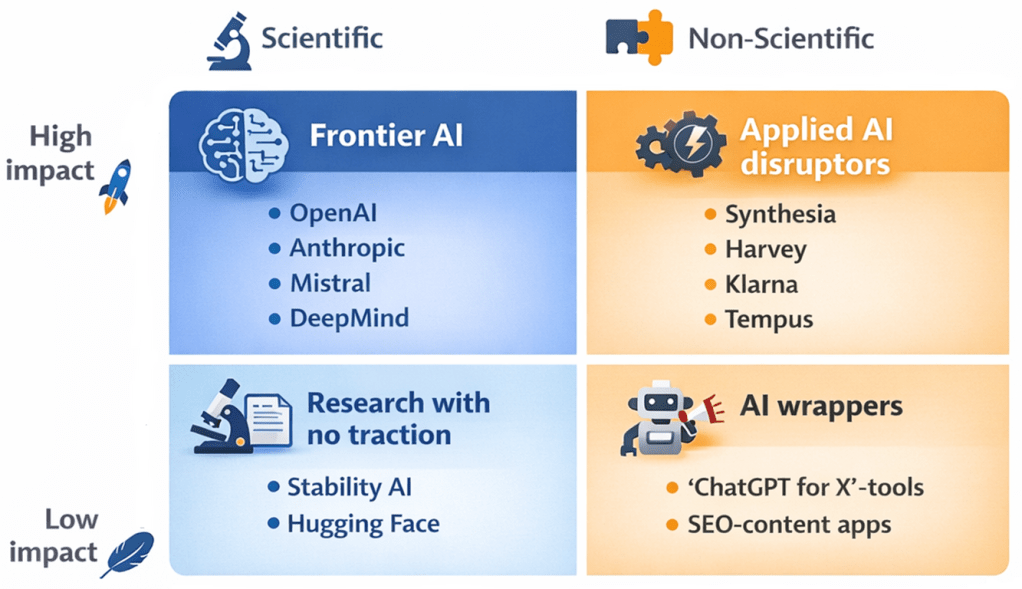
The table below shows the 4 types of AI startups available. They are categorized in a 2×2 matrix with the following axes:
– Scientific ↔ Non-scientific (extent of fundamental R&D, new models, papers, technical breakthroughs)
– High impact ↔ Low impact (extent to which the solution changes markets, is scalable, or creates structural value)
| AI Startup Types | Scientific | Non-scientific |
|---|---|---|
| High impact | (1) Deep Tech AI | (2) Applied AI Disruptors |
| Low impact | (3) Research-driven | (4) AI Wrappers |
Summary per type:
- Deep-Tech Innovators (Scientific + High impact)
- Startups building new models, algorithms, or hardware
- High technical risk, but potentially market-shaping
- Extremely cost-intensive
- Applied AI Disruptors (Non-scientific + High impact)
- Startups applying existing AI models to large markets
- Strong product execution and distribution
- Research-driven Niche Builders (Scientific + Low impact)
- Strong R&D companies, but with limited commercial scope
- Often academic or hyper-specialized
- AI Wrappers (Non-scientific + Low impact)
- Companies building simple wrappers around existing models
- No Intellectual Property (IP)
A complete description of all types can be found in the attachment, where the output of both chatbots is saved. The next section focuses on the differences per type regarding used symbols, descriptions, and company examples.
Differences ChatGPT and Copilot
Symbols
The symbols used per type are indicated here.
- Copilot
- 🌋 Scientific + High impact
- 🚀 Non-scientific + High impact
- 🔬 Scientific + Low impact
- 🧩 Non-scientific + Low impact
- ChatGPT
- 🧠 Scientific + High impact
- 🚀 Non-scientific + High impact
- 🧪 Scientific + Low impact
- 🧩 Non-scientific + Low impact
Descriptions
Descriptions are rather similar. ChatGPT provides a slightly more extensive description for all types, and Copilot stresses the high technical risk for type 1. It is up to the reader to take note of the complete list of descriptions, refer to the attachment.
- Copilot
- High technical risk
- –
- Hyper-specialized
- Low defensibility (IP)
- ChatGPT
- High defensibility (IP)
- Domains healthcare/law/logistics
- Can become impactful later, but not initially
- –
Examples
What stands out is that almost the same companies are mentioned for type 1, and all different ones for type 2 and type 3. It is up to the reader to take note of the complete list of example companies, refer to the attachment.
- Copilot
- Cerebras
- Jasper, Runway, Gong, UIPath, Synthesia
- Aiforia, Prophesee, LatticeFlow, Valence Discovery
- AI tools: Website-builder, PDF-summarizer, email-replier
- ChatGPT
- –
- Stripe, Notion, Harvey AI, Klarna
- EleutherAI
- SEO-content generators
Conclusion
The topic of AI startup types is discussed, from which both founders and investors can benefit. Additionally, it is recommended to consult multiple chatbots for specific research. This yields the most reliable information.
Attachements
The following 2 prompts are given to both chatbots in succession:
Can you represent the 4 types of AI startups in a 2×2 matrix with regard to (non-)scientific and (low-)impact?
Yes please, give me examples


Leave a Reply