
Introduction
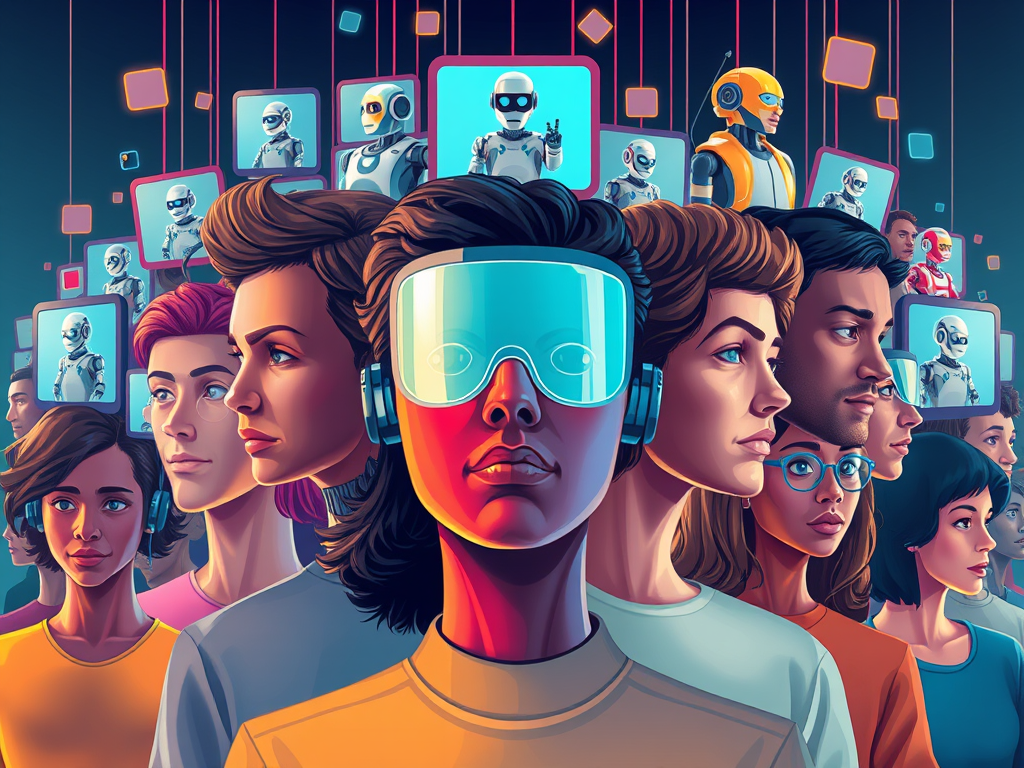
Chatbots like ChatGPT and Claude are influencing us to produce a uniform product. They are also making us think alike. This is according to a new study by computer scientists and psychologists[1].
A billion people worldwide now use a handful of AI tools daily. They compose emails, improve texts, brainstorm ideas, solve problems, write code, and create videos. As a result, our texts, our reasoning, and even our opinions are becoming increasingly similar. Researchers from the University of Southern California call this “cognitive homogenization” in a new study.
Finally, I will mention a number of counterarguments from own experience. I will also propose a method to prevent the mentioned effects from occurring in general.
What is Cognitive Homogenization by AI?
The following paragraphs explain the phenomenon further.
Why chatbots are narrowing perspectives and styles
A chatbot is trained on an unimaginable amount of text from the internet and scanned materials. From all that text, the model learns which language and reasoning patterns occur most frequently and then spits them out. This creates a kind of statistical average in the form of soulless texts that sound correct and polished.
When you have a chatbot rewrite your email, your personal style disappears. Instead, you get a polished but generic version. Do that with millions of people simultaneously, and everyone starts to sound the same. Just scroll through LinkedIn to see for yourself. Researchers warn of a significant danger. We risk losing variety in language and logic. This happens because everything and everyone starts saying the same thing.
Shifts in reasoning and human agency
Chatbots also effectively influence our thinking. Previous studies indicate that interacting with a chatbot can influence people. When the chatbot shares a particular perspective, individuals unconsciously adjust their own opinions accordingly.
Chatbots also guide our logic. Every LLM text you read is structured in the same step-by-step manner. However, that’s not always the best approach. Sometimes, creative thinking actually helps you arrive at the right answer faster.
Group stereotyping on a global scale
Moreover, chatbot training data isn’t representative of the entire world. English and Western thought are significantly over-represented. This means that the “standard” chatbots primarily reflect Western norms and values. They do so at the expense of other cultural perspectives.
And even if you don’t use a chatbot yourself, you can’t avoid it. If everyone around you begins to use the same AI-polished language and ideas, you will feel social pressure. The researchers argue that you will be urged to conform.

Counterarguments and suggestions
Personally, I disagree with the discussed effects in general, because there are various counterarguments to be mentioned. A workflow is recommended, based on personal experience.
Counterarguments
- Especially when writing scientific articles, using a chatbot is essential for gathering as much information as possible. You simply can’t ignore it. If you don’t use it, others will vastly outperform you with their content.
- Brain activity will be stimulated by asking questions, and according answers will lead to more questions.
- It’s essential to ask for feedback on your own content. You often don’t see your own mistakes, and the tool will spot them flawlessly.
- Last but not least: The described effect is said to be caused purely by LLMs. However, these are not the end-all-be-all of the current AI hype, as World Models are also emerging. In short, it will be a temporary effect.
Recommended workflow
- Develop a subject, inspired by someone else’s idea or article
- Ask the chatbot questions about the subject. Answers generate more questions. Archive the conversation
- Start writing your content, using your archive and other sources, such as search queries, documents, images, etc.
- Afterward, ask for feedback and make corrections. Avoid automatic rewriting as much as possible
- Ask for title options and generate a feature image
- Ensure the reading grade score is high enough. For scientific articles, a balance must be made between sufficient depth and readability for non-technical readers
- If applicable, add a glossary and a reference list
- Optional: make adjustments afterwards based on further consideration and new insights
Conclusion
We must ensure we use AI tools correctly. Blindly generating text, images, and videos without our own input will lead to uniform products and even reduced brain activity. However, to keep up with the trends, they are also indispensable. A workflow has been recommended that minimizes the discussed effects.
References
[1] The homogenizing effect of large language models on human expression and thought, Zhivar Sourati, January 2026
Glossary of Terms
- Cognitive homogenization – Standardizing how people speak, write, and think by the use of AI chatbots
- LLM – Large Language Model
- World model – Model of a physical environment that allows an agent to simulate possible futures before acting
 inteso.ai - blog
Leave a comment